Don’t put your phone down. Thirty seconds.
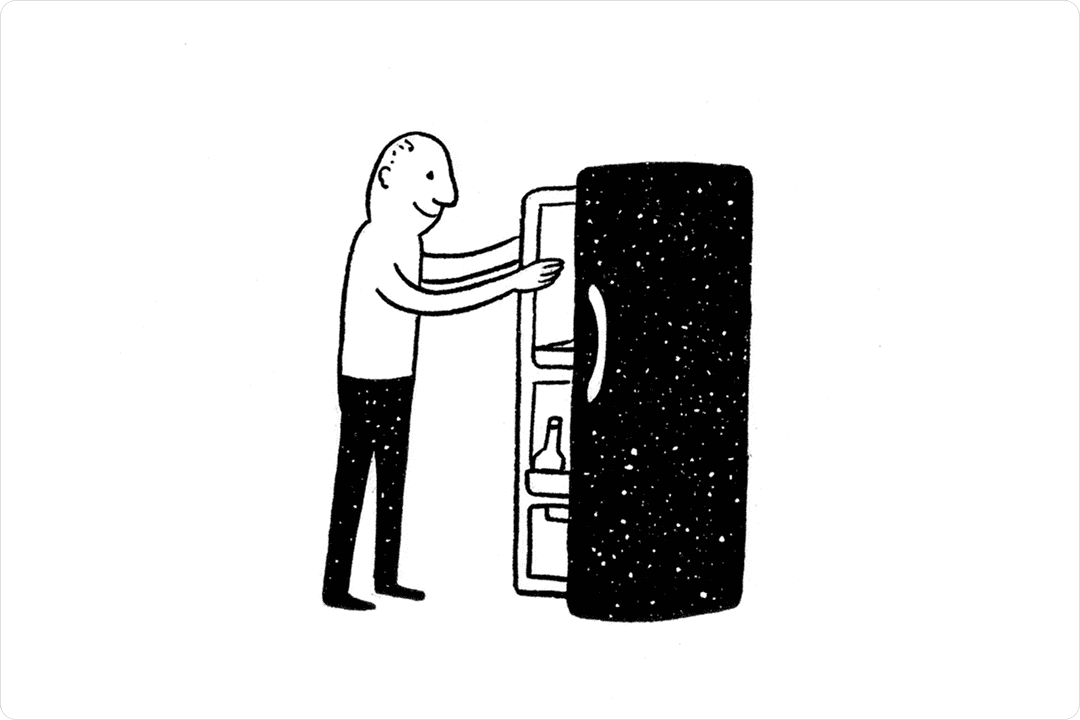
Explain how a refrigerator works. Not roughly. Not “something with gas” or “the motor makes it cold.” The mechanism. Where the cold comes from. What happens to the heat. Why the thing hums.
I’ll wait.
* * *
First comes the confidence. Of course you know how a refrigerator works — you open one every day. Then the attempt. There’s a compressor, and it cools the air somehow, and then —
And then nothing.
You’re not alone. In 2002 the psychologists Leonid Rozenblit and Frank Keil studied exactly this pattern at Yale University. They gave students a list of everyday objects — zippers, flush toilets, helicopters, sewing machines — and asked them to rate, on a scale of one to seven, how well they understood how each one worked. Participants gave themselves middling marks, just under four on average.
Then they were asked to write out the mechanism step by step.
After the attempt, ratings dropped by just under a point. Then came a diagnostic question — how do you pick a cylinder lock? — and the figure sat roughly a point and a half below where it started. “I have some idea” became “I have a vague notion, and not much more.” The two researchers called it the illusion of explanatory depth.
The refrigerator wasn’t on their list. It works anyway, and that’s precisely the point: the effect isn’t tied to the object.
Their finding, in one sentence: we believe we understand complex phenomena more precisely, more coherently and more deeply than we do. And we only notice when someone asks.
* * *
The striking thing about this effect isn’t the gap in knowledge. Everyone has gaps. The striking thing is the surprise.
Up until the moment you start explaining, your knowledge feels competent. It isn’t vague half-knowledge you’re papering over — it’s a quiet certainty that says sure, I know that. The gap only exists the moment you see it.
I ran the experiment once at a dinner party. Eight adults, all with university degrees. I asked whether anyone could explain how a flush toilet works. First laughter, then silence, then twenty minutes of discussion that ended with someone pulling out their phone. Nobody could explain it. Everyone had assumed they could.
* * *
Rozenblit and Keil worked out where the overestimation comes from — and ruled out the obvious answer.
They had forty devices rated on several scales: how familiar they were, how many parts they had, how many of those parts you can see while the thing is running. Then they checked which of those measures predicted the overestimation. Familiarity didn’t. Neither did the number of parts. It was the ratio of visible to hidden parts — a single value that accounted for nearly half the variation.
Das ist präziser als die übliche Erzählung, wonach wir Vertrautheit mit Verstehen verwechseln. Was du am Gegenstand ablesen kannst, verbuchst du als Wissen in deinem Kopf. Der Reissverschluss liegt offen da, die Zähne sichtbar, der Schieber auch; solange du hinsiehst, musst du nichts erinnern. Nimm ihn weg, und du merkst, wie wenig davon in dir war.
That’s more precise than the usual story, which says we mistake familiarity for understanding. What you can read off an object, you file as knowledge in your head. A zipper lies there in the open, teeth visible, slider visible; as long as you’re looking at it, you don’t have to remember anything. Take it away and you notice how little of it was ever inside you.
That comes down to the structure of the knowledge itself. Factual knowledge has almost no middle ground: you know the capital of Portugal or you don’t, and there’s little in between. Explanatory knowledge is graded, with gradations, layers, depths. And that’s where the trap sits. We mistake understanding a little for understanding; we sense an outline and read that feeling as competence.
You have no direct access to what you know. You only have access to what knowing something feels like.
That feeling lies.
* * *
It’s worth hearing the objection Rozenblit and Keil raise against themselves at this point.
The illusion, they write, might be necessary. It ends a search that would otherwise have no end. Anyone who followed every explanation to the bottom would never get through the day. The feeling of knowing enough is the dial that switches the search off.
The objection holds. It only shifts the question. If the illusion is the dial, then the question that matters is who sits at it.
In 2002, you did. The refrigerator did nothing to help you along with your illusion. It just stood there.
* * *
Try the test on something else. How does a bicycle’s gear system work? What happens in your body when you sneeze? Why is the sky blue rather than violet, given that violet light scatters more?
Try to explain it. Thirty seconds, out loud or written down. You’ll get the same pattern: the feeling, sure, I know that. The attempt. The gap.
Then ask yourself the same question after the next explanation a system hands you.
* * *
The full essay on this topic: